
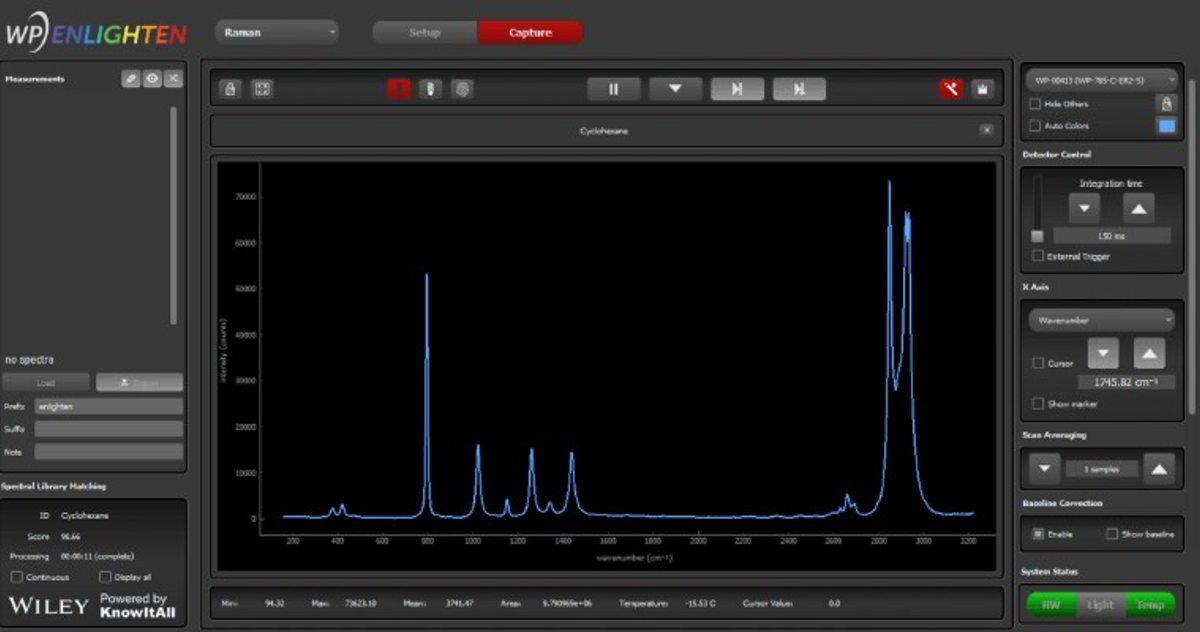
Raman Library Matching
ENLIGHTEN™ software integrates with the KnowItAll spectral search engine and Wiley Science Solutions Raman library, enabling spectrum acquisition and analysis within a single platform for fast and reliable material identification, verification, and validation.
With access to a database of over 25,000 spectra, a wide range of organic, inorganic, pharmaceutical, polymer, and specialty materials can be easily identified. Users can also create custom libraries for advanced comparative analysis.
ENLIGHTEN™ Raman Library Features
• Integrated spectrum acquisition and analysis • Built-in KnowItAll spectral search engine • 25,000+ reference spectra database • Automated matching score evaluation • Custom user library creation • Advanced spectral processing tools • Fast and reliable material identification
How it works ?
ENLIGHTEN™ processes the acquired Raman spectrum and compares it against library data using:
• Region of Interest (ROI) trimming • Instrument response calibration • Baseline correction (fluorescence removal) • Spectral deconvolution (peak sharpening)
These steps ensure highly accurate, like-for-like comparison with reference spectra.
How Do We Ensure the Best Match in ENLIGHTEN™?
We implement multiple spectral pre-processing steps before sending spectra to the KnowItAll spectral identification engine to ensure the most confident match against the extensive Raman library. These steps ensure a like-for-like comparison with the library data.
These processes address spectral response, range and resolution, and baseline correction to ensure proper data alignment for accurate matching.
Spectral Pre-Processing Steps
ENLIGHTEN™ applies several pre-processing steps to ensure accurate and reliable library matching:
• Region of Interest (ROI) Trimming: Spectral extremes are removed where the laser blocking filter is active or detector sensitivity is low. • Intensity Calibration: The instrument’s unique spectral response function is corrected using a standard reference material (SRM) measured at the factory. • Deconvolution: Spectral peaks are mathematically sharpened to more closely resemble high-resolution spectra acquired with benchtop instruments. • Baseline Correction: A smooth curve is fitted to remove potential background fluorescence, resulting in a clean Raman spectrum similar to library data.